Top Mistakes: Why Google Removed Your Review
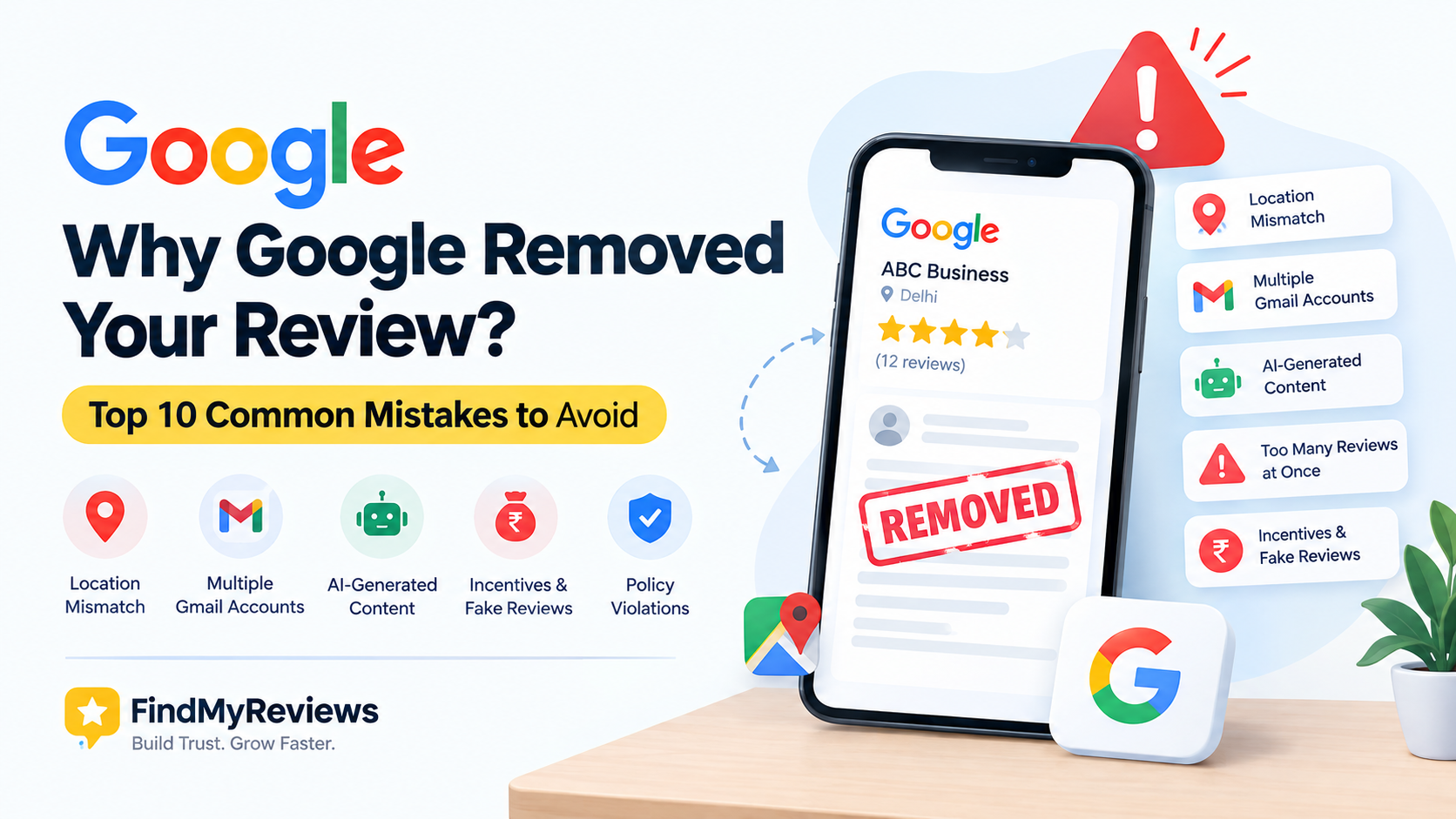
Have you ever left a Google review for a business, only to discover that it disappeared a few hours or days later? You are not alone. Many business owners and customers experience situations where Google reviews are missing, not visible publicly, or removed from a Google Business Profile.
For local businesses in India, Google reviews play an important role in building trust and helping potential customers evaluate their services. When reviews disappear frequently, business owners may become confused about what went wrong.
In this article, we will explain the top mistakes that can cause Google reviews to be removed, how location, Gmail accounts, AI-generated content, and suspicious activity can affect reviews, and what businesses can do to encourage genuine customer feedback.
1. Location Mismatch Between the Reviewer and Business
One common concern is the location difference between the person leaving a review and the business receiving it.
For example, imagine a business is located in Delhi, but a customer lives in Mumbai and leaves a review after visiting the business during a trip.
This situation is not automatically a problem. Genuine customers can review businesses in other cities, and Google does not require every reviewer to live near the business.
However, a review may appear less credible when its content, timing, account activity, and other signals do not seem consistent with a genuine customer experience.
How to avoid problems
Leave a review based on an actual experience with the business.
Describe the service, product, or visit accurately.
Do not claim to have visited a location if you have not.
Avoid posting reviews on behalf of other people.
Important: A difference between the reviewer's current location and the business location does not, by itself, prove that a review will be removed.
2. Using Multiple Gmail Accounts to Post Reviews
Another common misconception is that creating a new Gmail account will prevent reviews from being removed.
Google may evaluate multiple signals when determining whether content complies with its policies. Creating additional accounts does not guarantee that a review will remain published.
Using multiple accounts to post reviews for the same business, or to make feedback appear to come from different customers, can create a misleading impression.
What should you do instead?
If you are a genuine customer, use an account you normally use and share your honest experience.
If a legitimate review disappears, check whether it violates Google's review policies and consider reporting the issue through the appropriate Google support channel.
Remember: A new Gmail account is not a reliable solution for missing reviews.
3. Using AI to Write Generic or Repetitive Reviews
AI writing tools can generate review text in seconds. However, reviews that contain generic statements, repetitive wording, or fabricated details may not accurately reflect a customer's experience.
For example, the following review provides little meaningful information:
"Excellent service. Best company. Highly recommended. Five stars."
This type of wording is not automatically prohibited, but repeatedly posting similar content or generating reviews without genuine customer experiences can raise concerns.
How to write a more useful review
A genuine review should reflect the customer's own experience and opinions.
For example:
"I recently purchased a product from this store. The staff explained the available options clearly, and my order arrived on the expected date. Overall, I had a positive experience."
This example is appropriate only if it accurately describes what the customer experienced.
AI can help with spelling or grammar, but it should not invent customer experiences or be used to manufacture reviews.
4. Posting Reviews Without Actually Using the Business
Google reviews are intended to reflect genuine experiences with businesses, products, or services.
A person who has never purchased from or used a business should not pretend to be a customer.
For example, posting a review about a restaurant's food without visiting it, or reviewing a service that was never received, can mislead other customers.
Best practice
Ask real customers to share honest feedback after they have interacted with your business. Do not purchase fabricated reviews or ask people to claim experiences they never had.
5. Posting Too Many Reviews in a Short Period
A sudden increase in reviews can sometimes attract scrutiny, particularly when the activity involves repetitive content, fake accounts, incentives, or other suspicious patterns.
However, receiving many reviews in a short period does not automatically mean that a business has violated Google's policies. A successful promotion or a busy period can also lead to a genuine increase in customer feedback.
How businesses can reduce review-related problems
Ask customers for honest feedback as part of your normal customer service process.
Avoid bulk-generated or fabricated reviews.
Do not require customers to leave a particular star rating.
Do not offer rewards in exchange for positive reviews.
Focus on genuine customer feedback rather than trying to control the number or timing of reviews.
6. Offering Money or Discounts for Positive Reviews
Some businesses offer discounts, cashback, gifts, or other benefits in exchange for five-star Google reviews.
This can violate Google's policies on fake engagement and incentivized reviews.
Even if a customer is real, offering a reward in exchange for a positive rating can compromise the authenticity of the feedback.
The better approach
You can ask customers to leave an honest review without offering an incentive. Customers should remain free to share positive, neutral, or negative feedback.
7. Posting the Same Review Across Multiple Businesses
Copying and pasting identical review text across several businesses may make feedback less useful and can contribute to suspicious review patterns.
For example, repeatedly publishing the same generic statement for unrelated restaurants, salons, clinics, or agencies does not provide meaningful information about individual customer experiences.
Customers should describe the specific business and experience they are reviewing.
Do not fabricate different experiences simply to make repetitive reviews appear unique.
8. Including Irrelevant Links, Promotional Content, or Personal Information
Reviews are intended to help people understand genuine customer experiences. Content that is primarily promotional, irrelevant, abusive, or contains inappropriate personal information may violate Google's content policies.
Examples include:
Advertising unrelated products or services.
Posting spam links.
Repeatedly promoting a website in review text.
Publishing another person's private information.
Using reviews to harass a business or individual.
Keep feedback relevant to the actual customer experience and avoid unnecessary personal information.
9. Reviewing Your Own Business or Using Conflicted Accounts
Business owners should not use reviews to artificially improve their own ratings. Reviews from employees, business associates, or other people with a conflict of interest may also violate Google's policies, depending on the circumstances.
The purpose of a review is to provide independent customer feedback.
Instead of asking staff members or business partners to boost your rating, build a process for inviting genuine customers to share their experiences.
10. Assuming Every Missing Review Has Been Deleted
Sometimes, a review may not be visible because of a technical issue, a delay, a policy filter, or a change in the reviewer's account.
It is important to distinguish between a review that has been removed and one that is temporarily not appearing.
What to do if your review disappears
Check the Google account used to post the review.
Review Google's policies on prohibited and restricted content.
Check for notifications or explanations from Google.
If you believe a genuine review was incorrectly removed, use Google's official support or appeal options where available.
Avoid repeatedly reposting the same review or creating accounts to get around a restriction.
There is no guaranteed method to make a review stay published. Google ultimately determines whether submitted content complies with its policies.
How Business Owners Can Reduce Google Review Loss
If you operate a local business in India and notice that reviews frequently disappear, focus on the quality and authenticity of your review collection process.
Here are some practical steps:
Request genuine feedback: Invite actual customers to share their experiences.
Use a direct review link: Make it easy for customers to find your Google review page.
Avoid incentives: Never exchange discounts or gifts for positive ratings.
Keep requests neutral: Ask for honest feedback rather than specifically requesting five-star reviews.
Avoid fabricated content: Do not create reviews using fake identities or invented experiences.
Monitor your profile: Check for missing reviews and official policy notifications.
Improve customer service: Satisfied customers are more likely to share positive feedback voluntarily.
Following these practices cannot guarantee that every review will remain visible, but they support a more trustworthy and sustainable reputation-management strategy.
Frequently Asked Questions
Why did Google remove my review?
Google may remove reviews that violate its policies or identify them as suspicious. Other possibilities include account restrictions or technical issues. The exact reason may not always be visible to the reviewer.
Does Google remove reviews because of location differences?
Not necessarily. A customer can review a business in another city if the review reflects a genuine experience. A location mismatch alone does not establish a policy violation.
Will creating a new Gmail account stop Google from removing reviews?
No. A new account does not guarantee that a review will remain published. Creating accounts to manipulate ratings or bypass restrictions can make the situation worse.
Can AI-written Google reviews be removed?
AI assistance alone does not automatically mean a review violates Google's policies. However, fabricated experiences, repetitive content, and reviews created to manipulate ratings can violate those policies.
Can a business recover deleted Google reviews?
Sometimes, a legitimate review may be eligible for review or appeal through Google's official support channels. Recovery is not guaranteed, and businesses should avoid reposting fabricated feedback.
How can I get more genuine Google reviews in India?
Ask real customers for honest feedback after a purchase or completed service. Share your review link, keep requests neutral, and respond professionally to customer feedback.
Conclusion
Google reviews are an important part of online reputation management, but not every submitted review is guaranteed to appear publicly.
Location differences, multiple accounts, repetitive content, fabricated experiences, incentives, and policy violations are all worth understanding when investigating missing reviews. However, no single factor automatically explains every removal.
For businesses, the most sustainable strategy is to collect authentic feedback from real customers and follow Google's review policies.
Want to improve your online reputation? Visit FindMyReviews to explore review-management resources and learn more about building a trustworthy online presence.